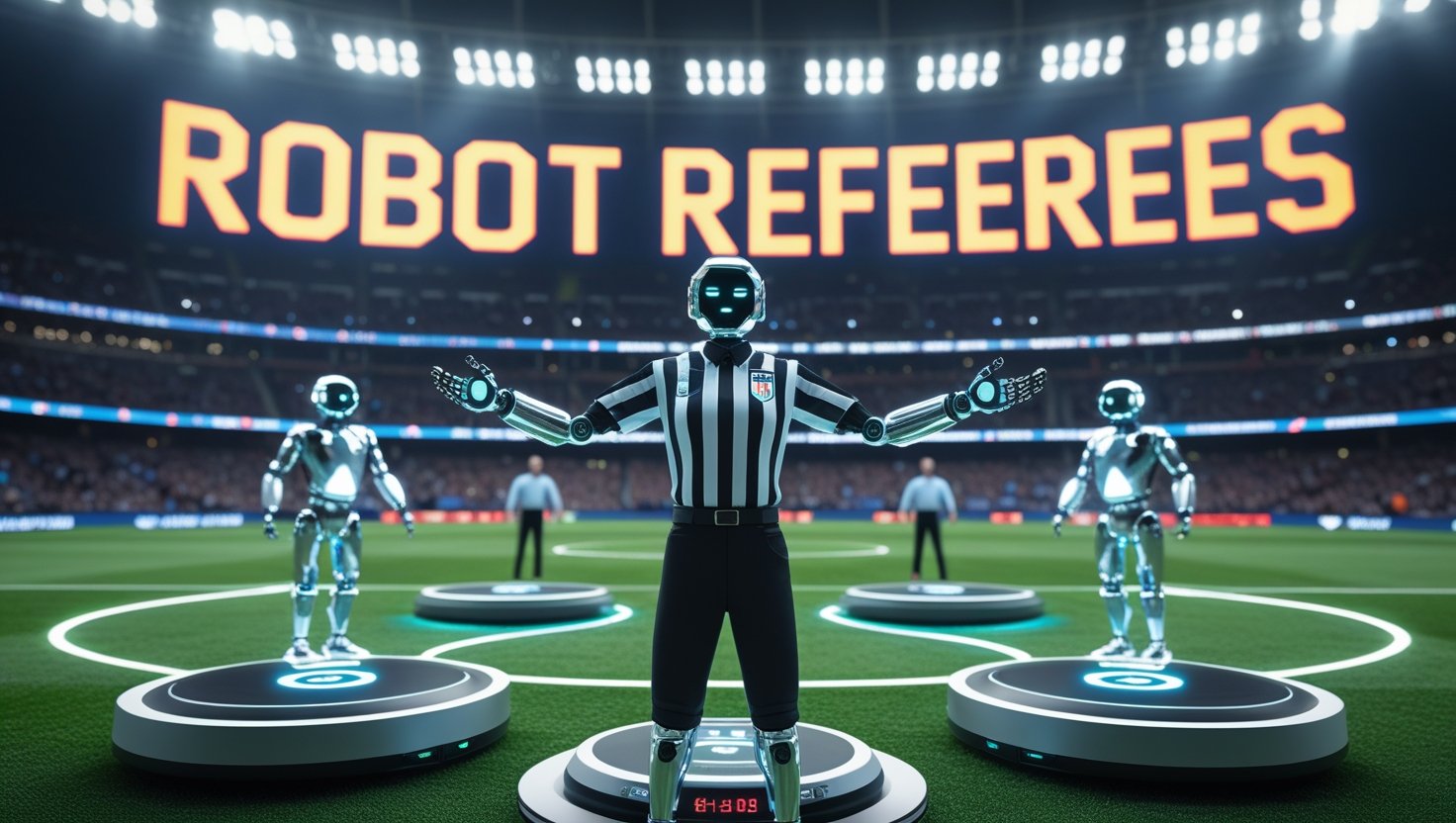
Imagine flawless decisions, made in the blink of an eye, free from human error and bias. Robot Referees powered by AI are set to transform sports officiating by replacing traditional human officials. As cutting-edge technology meets athletic tradition, this article explores how automated rulings could revolutionize the field, ensuring fairness, consistency, and a new level of accuracy in every match.
When Machines Whistle:
The evolution of sports officiating has been gradual, yet revolutionary. Today, technologies like the VAR (Video Assistant Referee) have already paved the way for digital assistance in critical game decisions. Now, the concept of fully autonomous Robot Referees is gaining momentum. This innovation stems from the desire to eradicate human limitations such as fatigue, subconscious bias, and uneven interpretation of the rules.
Robot referees harness state-of-the-art AI algorithms, advanced sensors, and real-time video processing to assess game situations with unprecedented precision. By relying on extensive databases of historical gameplay and rule interpretations, these automated systems promise to deliver unbiased decisions every time. This approach represents not only a technical upgrade but also a cultural shift in sports, challenging long-standing traditions and redefining how fairness is delivered on the pitch.
Integral to this transition is the recognition that as sports become faster and more dynamic, the need for split-second, objective decisions grows more critical. As we witness the rise of Robot Referees, the boundary between human expertise and machine efficiency begins to blur, setting the stage for a new era in sports officiating that blends the best of both worlds.
Precision and Consistency:
One of the biggest attractions behind implementing Robot Referees is their potential to offer unparalleled consistency. Human referees, no matter how experienced, are subject to variances in judgment and can be influenced by external pressures—from the roar of the crowd to the intensity of rivalries. In contrast, AI systems are designed to apply rules uniformly across every match without hesitation or distraction.
By analyzing game footage in real time through high-definition cameras and sophisticated sensor networks, Robot Referees can detect fouls, offside positions, and other rule infringements with laser-like precision. These systems utilize machine learning to continuously improve their decision-making process by learning from past games, ensuring that every call is supported by data-driven accuracy.
Moreover, this level of consistency enhances the fairness of the sport. Athletes and coaches can trust that every decision is grounded in measurable facts rather than subjective interpretation. The promise of unwavering consistency is particularly appealing to leagues and sporting bodies that aim to standardize officiating across competitions, minimizing controversy and improving the overall credibility of the sport.
Technological Brilliance:
The backbone of Robot Referees lies in the convergence of multiple advanced technologies. At its core, high-speed cameras and networked sensors capture every moment on the field, feeding vast amounts of data into robust AI systems. These systems then process the information in real time, comparing current gameplay against a comprehensive set of rules and historical precedents.
Key to this process is machine vision, the technology that allows computers to “see” and interpret the field of play. Combined with deep learning techniques, these systems can distinguish between genuine fouls and accidental contacts, understand the dynamics of player movement, and judge subtle differences that even trained human eyes might miss. This high level of detail is essential to ensure that the decisions made are both fair and contextually appropriate.
Furthermore, integration with digital communication networks means that any decision can be instantly relayed to players, coaches, and spectators. This seamless synchronization between hardware and software not only bolsters the Digital Shield against human error but also reinforces the overall reliability of the officiating process. With such cutting-edge capabilities, Robot Referees are poised to become a transformative force in the realm of sports.
Blending Tradition with Innovation:
Introducing Robot Referees into sports is not simply a technological upgrade; it signals a major cultural transformation. Sports have long been steeped in tradition, with human referees seen as integral to the “soul” of the game. Their on-field presence, spontaneous interactions with players, and occasional controversial calls have become part of the sport’s narrative.
Yet, this human element also introduces inconsistencies and biases. By integrating AI as a regulatory force, leagues can ensure that every decision is made on a purely factual basis. This shift is not about discarding tradition; rather, it is about augmenting the game’s integrity. Many experts argue that while the human touch adds drama and excitement, the cost of error may sometimes be too high, especially in high-stakes competitions.
The challenge lies in balancing the benefits of automated precision with the spirit of traditional sportsmanship. Hybrid models are already emerging, where human referees work alongside AI assistants, blending intuitive judgment with technological rigor. As this collaboration evolves, sports culture could embrace a future where both tradition and innovation coexist, elevating the game to new heights where fair play is not compromised for the sake of spectacle.
Challenges on the Pitch:
Despite the promising outlook, the transition to Robot Referees is fraught with challenges. One of the foremost concerns is the assimilation of subjective judgment into a digital framework. Certain incidents require nuance, distinguishing between a genuine foul and accidental contact or understanding the context behind a player’s actions. Critics point out that even the most advanced algorithms may struggle to capture the full spectrum of human emotion and intention.
Moreover, technical glitches, sensor malfunctions, or software bugs can lead to erroneous calls, problems that could drastically alter the outcome of critical matches. Just as human error can tarnish a game, so too can a malfunctioning system undermine the confidence of players and fans alike. Regulatory issues also arise; sports governing bodies must outline clear protocols for the use of AI, while ensuring these systems remain transparent and accountable.
Ethical considerations further complicate the picture. The loss of the human element, characterized by on-field leadership and the personal connection with the game, remains a significant concern. Many fans cherish the unpredictability of human decisions, and removing that could alter the viewing experience. In this complex landscape, implementing Robot Referees will require robust solutions to technical, ethical, and regulatory challenges, ensuring that innovation does not come at the expense of the sport’s integrity.
Future Vision:
Looking ahead, the future of officiating in sports may very well be a hybrid model where Robot Referees and human officials work in tandem. As research and development continue to refine AI capabilities, we can expect systems that not only deliver perfect consistency but also learn to handle nuances by drawing on vast datasets and evolving algorithms.
Innovations like real-time data analytics, predictive modeling, and even virtual reality simulations could further enhance the decision-making process. By integrating these technologies into a collaborative framework, sporting organizations could offer a new standard of fairness, where critical calls are made with both precision and human empathy.
This future-themed approach promises to transform the viewing experience by reducing controversies and disputes while maintaining the excitement and unpredictability of sports. As stakeholder buy-in increases—from league administrators to tech experts and fans—the roadmap for implementing AI-driven officiating will undoubtedly become more defined. In this transformative era, a well-designed Digital Shield for sports not only safeguards the integrity of the game but also paves the way for a bold new chapter in sports culture.
Conclusion:
The advent of Robot Referees powered by AI signals a revolutionary shift in sports officiating. While challenges remain, the blend of precision, consistency, and cutting-edge technology promises a future where fairness reigns supreme. Embracing this change could lead to sports that are not only more accurate but also more transparent and trustworthy.
FAQs:
- What are Robot Referees?
They are AI-driven systems designed to make unbiased, precise decisions in sports officiating. - Can AI truly replace human officials?
AI can enhance consistency and fairness, though many envision a hybrid model rather than a complete replacement. - How do Robot Referees improve decision-making?
They use advanced sensors and machine learning to analyze real-time data, reducing human error. - What challenges does AI officiating face?
Challenges include technical glitches, capturing subjective nuances, and regulatory hurdles. - Will fans miss human referees?
Some fans cherish human interaction, but many appreciate the promise of fair and consistent rulings. - What is the future of sports officiating?
The future may blend AI precision with human judgment, creating a more balanced and fair game.
About the Author